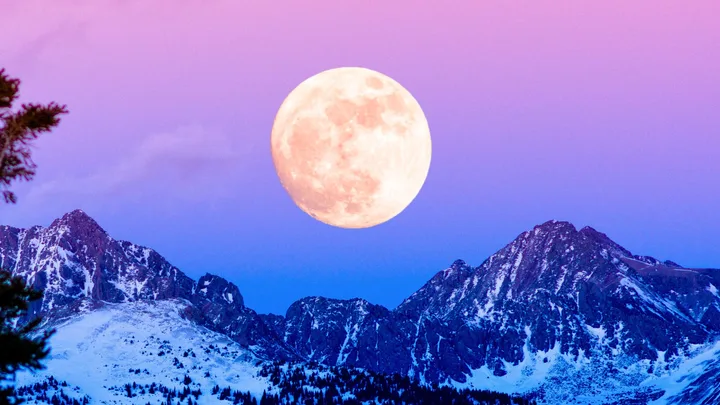
December has arrived with one final celestial moment to mark the close of the year.
In 2025, the last full moon isn’t just any full moon, it’s a Cold Supermoon, rising in Taurus and completing a rare run of three consecutive supermoons across October, November and December.

Trailing only November’s Beaver Moon in size, the Cold Supermoon will appear noticeably brighter than a standard full moon, bringing the year’s final lunar highlight into view.
Below, we break down what makes it a supermoon, where its name comes from and when and where to catch it in Australian skies.
The December full moon will reach its peak tomorrow, on Friday, December 5.
Because the moon will be at perigee (its closest point to Earth) it qualifies as a supermoon — meaning it will appear subtly larger and more luminous than a standard full moon. If skies are clear, it’s the perfect excuse to step outside after sunset and look toward the eastern horizon.
The Cold Supermoon will appear shortly after sunset, however the best viewing window will depend on where you are — those in Brisbane will see the Super Cold Moon from as early as 7.07pm while those in Hobart will have to hold out until 9.28pm. See the best time slot for you city, below.
| City | Time |
|---|---|
| Sydney | 8:35pm |
| Melbourne | 9:16pm |
| Brisbane | 7:07pm |
| Perth | 7:57pm |
| Canberra | 8:49pm |
| Adelaide | 9:02pm |
| Darwin | 7:31pm |
| Hobart | 9:28pm |
Each full moon carries a traditional name rooted in ancient seasonal rhythms. Many of these names originate in the Northern Hemisphere and Indigenous North American traditions. As December marks the onset of winter in the north, the full moon earned the name Cold Moon.
This year’s version becomes the Cold Supermoon simply because its orbit brings it closer to Earth than usual.
Other historical names for December’s full moon include the “Long Night Moon”, referencing the year’s shortest days and longest nights; the “Moon Before Yule”, reflecting its proximity to the Christmas season; and the evocative “Oak Moon”.
Beyond its seasonal symbolism, the December 2025 full moon is distinguished by its supermoon status. Its proximity to Earth gives it a brighter glow and slightly enlarged appearance, particularly striking at moonrise.
It also completes a rare trio of consecutive supermoons — making it the final and perhaps most memorable lunar display of the year. Its brightness and texture make it especially photogenic for stargazers and photographers alike.
Across cultures, full moons have long symbolised culmination, release and reflection. Arriving at the close of the year, the Cold Moon carries a particularly poetic resonance — a quiet pause between endings and beginnings.
It’s a fitting moment to reflect on the year that’s passed, to release what no longer serves, and to prepare for what lies ahead. Whether you’re drawn to the romance of the night sky, the symbolism of lunar cycles, or simply the quiet beauty of a bright December moon, this final supermoon of 2025 offers a moment of light to carry into the new year.
We will see just three supermoons in 2026, with the first arriving on January 3. If you miss it, the next will not appear until November 2026, followed by one in December.