

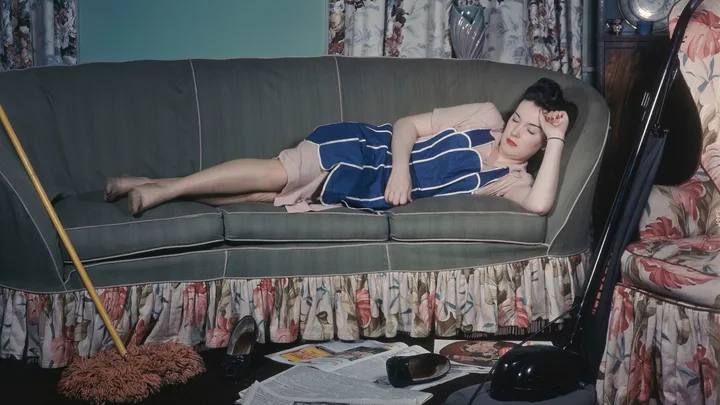
While some work is captured in payroll systems, much of the most essential labour takes place within the invisible rhythms of domestic life — the cooking, cleaning, laundry and school runs that keep everything else turning. It is the unpaid scaffolding that holds the paid economy upright, and without it, society would simply not function.
A new study published in The Economic Record by economist Dr Leonora Risse has finally put a price tag on that ‘invisible’ work, and the result is staggering.


The total value of Australia’s unpaid labour is estimated at A$688 billion a year, roughly one-third of the nation’s GDP, with the vast majority carried by women.
How Can This ‘Invisible’ Labour Be Quantified?
To understand how this was calculated, Risse mapped everyday unpaid tasks to their paid-market equivalents — the hourly rate of a childcare worker for time spent with children, a cleaner’s rate for housework, a kitchen hand’s for cooking, and a housekeeper’s for shopping and general errands.
Using these benchmarks, women’s unpaid contribution amounts to A$427 billion annually, compared with A$261 billion for men. On average, women devote nearly four hours a day to unpaid work, while men average about two and a half.

Traditional economic measures such as GDP account only for paid employment, making women’s contribution appear smaller at about 36.8 per cent of total labour. When unpaid care and domestic work are included, that figure rises to 47.2 per cent.
Yet Risse goes further, correcting for a long-standing truth: the jobs used as proxies for unpaid work, such as childcare, cleaning and domestic support, exist within female-dominated sectors that are undervalued precisely because they are associated with women.
When she adjusts for this “gender discount,” women’s contribution increases again, reaching 50.5 per cent of all labour in Australia. In other words, when we properly value women’s work, equality finally comes into view.
Devalued By Design
Risse’s findings also expose how women’s work, both paid and unpaid, continues to be devalued on principle rather than performance. Hourly wages remain lower in female-concentrated occupations and industries, even when education and experience are comparable.
This undervaluation extends beyond the workplace, shaping how we perceive similar tasks at home. Skills such as care, communication and emotional management are too often viewed as innate rather than learned, a quiet bias that keeps both forms of labour under priced.
If GDP is the scoreboard, it’s been keeping half the game off the field. During the pandemic, when schools and services closed, households (particularly women) absorbed the shock. GDP contracted, yet women’s unpaid hours soared.
The result is a distortion that affects everything from how we set wages in feminised sectors to how we measure productivity, since the benefits of quality care extend far beyond the financial quarter.
The unpaid work that sustains homes, families and futures is not invisible, we have simply chosen not to look. To value it is to finally see the economy as it really is: powered by women.

